
University’s one-page strategic plan launches La Sierra forward

Above, President Christon Arthur delivers a sermon on Feb. 7, 2026 at Camelback SDA Church in Phoenix. The university's objectives include strengthening relationships with Adventist churches and schools. Below, Arthur speaks to high school and junior high students for chapel at San Gabriel Academy.

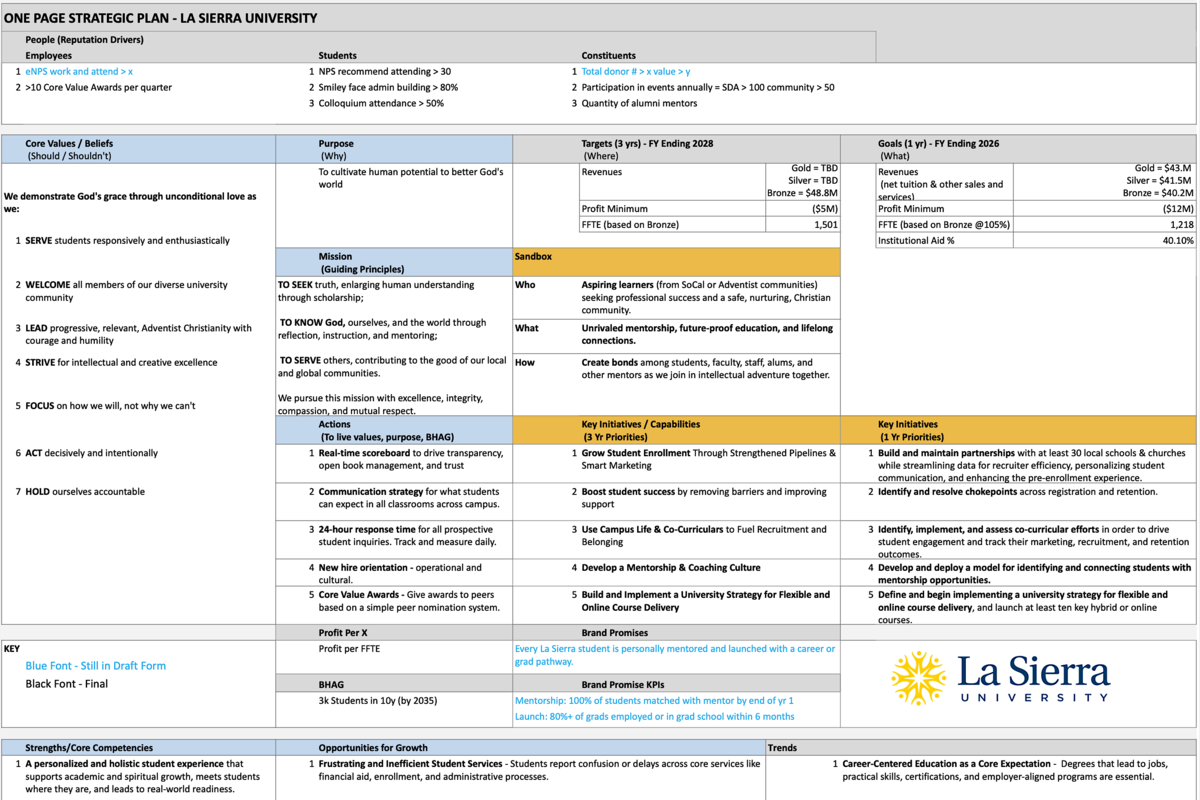
La Sierra University's new strategic plan is summarized on one page. Click the image to expand.
The La Sierra University Board of Trustees approved the plan in November, allowing the Seventh-day Adventist university to move forward with actions designed to reach one and three-year enrollment objectives aimed at a larger preliminary target of 3,000 students by 2035.
The plan is summarized on one page in chart form, a unique approach to strategic planning in higher education and drawn from corporate methodologies such as Scaling Up and Traction which are used by hundreds of thousands of companies. The plan represents a first long-range university blueprint since 2022 when the last strategic plan expired. It sets in motion strategies that are buoyed by an enrollment upswing last fall that ended several years of declines–– this year’s fall quarter, La Sierra University experienced a 26% surge in new freshmen, a 38% increase in new graduate students, and a 24% increase in total new students. The university’s enrollment totaled 1,602 as of Oct. 1, its official census date, representing an overall enrollment increase of 5%.
For La Sierra University President Christon Arthur, who is in his second year at the university’s helm, the approval of the plan represents a significant milestone and streamlined pathway forward. The plan was developed over the past year under the guidance of strategy development advisor and Zapara School of Business MBA alumnus David Blades, with extensive input from university leadership and campus groups. Blades is vice president of marketing at Jenson USA in Corona, Calif., one of the top retailers in the country for mountain bikes, road bikes and commuter bikes.
The one-page strategy is derived from the Scaling Up methodology that was designed for startup businesses and organizations thwarted by lack of revenue growth. Scaling Up is based on four pillars and with four key implementation tools including one-page strategic plans and quarterly planning and review processes.
The goals highlighted on La Sierra’s strategic plan document are being pursued through a cadence of quarterly accountability processes supported by weekly check-ins on progress that are based on key performance indicators (KPIs) for enrollment growth and retention.
Toward rallying employees around the increased enrollment goal last year, targets were set and divided into three categories named for Olympic medals – a gold medal goal of 500 new freshmen, a silver medal for reaching 400 and a bronze for achieving 300. The university came in just shy of the bronze goal last fall, but with significant percentage increases in major categories and in many academic programs.
“We almost got the bronze,” Arthur said. “But we didn’t feel defeated because we know that was our first attempt. It was to set our eyes on something, to stretch ourselves.”
The effectiveness of a strategic plan rests in setting goals that prompt an institution to extend itself, that allow for aspirational objectives and that speak to and reflect an institution’s identity and beliefs, Arthur noted. “We should have strategies that really speak to our core values our core beliefs, our core purpose. If we do this well, we become better at what we’re called to be.”
La Sierra University Core Values & Beliefs
We demonstrate God's grace through unconditional love as we:
- SERVE students responsively and enthusiastically.
- WELCOME all members of our diverse university community.
- LEAD progressive, relevant, Adventist Christianity with courage and humility.
- STRIVE for intellectual and creative excellence.
- FOCUS on how we will, not why we can't.
- ACT decisively and intentionally.
- HOLD ourselves accountable.
La Sierra University Purpose:
To cultivate human potential to better God's world.
Priorities spotlight
Due to increased societal, political, technological and economic fluctuations affecting the higher education landscape in recent years, long-ranging plans of 10 years or more have become difficult to implement, Arthur noted.
“So the three-year strategic plan came into vogue,” he said. “You wind up with a situation where, whether it’s three or five years, you get a percentage of the things done that you want accomplished.”
“All priorities are expected to help us make rapid progress toward achieving and executing on our goals." – David Blades, Strategic Planning Advisor
The approval of the strategic plan set last November in motion activities designed to track implementation of the three-year key initiatives, beginning with first year goals broken down by quarter. Arthur and Blades organized weekly 30-minute check-in meetings called Priority Pulse, which are open to the campus, during which reports are given on progress made toward defined goals in five key areas––partnerships with churches and schools toward bolstering student enrollment; development and implementation of co-curricular plans to drive student engagement and track retention; definition and implementation of flexible online learning; student mentorship by alumni and campus members; identification and resolution of ‘chokepoints’ related to student onboarding and other customer service-oriented activities.
Each of the five areas involves the work of cross-disciplinary groups whose efforts are guided each quarter by a team leader.
The five priority areas and their subcategories were devised through the Scaling Up method. “All priorities are expected to help us make rapid progress toward achieving and executing on our goals,” Blades said. “They are sometimes a stretch, and we may not hit every goal every time, but we are holding ourselves accountable collectively to the outcomes.”
“If there are no aspirational goals, your plan is not robust enough. If there are no stretch goals, your plan is too easy,” Arthur noted. The enrollment target of 500 new freshmen is an example of a stretch goal, he said, one that is reachable if the institution works hard and extends itself, while a goal of becoming the No. 1-ranked university might serve as an aspirational goal.
University trustee Meredith Jobe who voted to approve the one-page plan cited the importance of key performance indicators. “When I term off the board for the second time in June, I’ll have completed a total of 28 years on the La Sierra board,” he said. “During that time, I’ve seen a number of strategic plans with bold goals. What I appreciate about this plan is that it has measurable KPIs by which the board will be able to measure campus progress toward those goals in the same way faculty measure student progress toward learning goals. The KPIs transform a set of ambitious goals into goals with a pathway toward achieving those goals.”
During the board meeting in November that saw the plan’s approval, one trustee likened the one-page strategy summary to something from a football quarterback’s playbook.
“It was a good example that the board member came up with,” Blades said. “[But] it only takes you so far, right? If the team doesn't show up to practice, then good luck with the playbook working. Or if the team doesn't show up for the game, they're not going to have any wins.”
"…the quarterly priorities are almost like showing up to practice and showing up to the games.” – David Blades
At Jenson, Blades and the company’s chief executive worked with a consultant, a former Proctor & Gamble executive, over several years developing and implementing the Scaling Up method, with first steps involving the nurturance of a thriving company culture. The approach ultimately brought substantive revenue growth to the company.
Blades noted that Scaling Up draws from the principles put forth in the book, “The 7 Habits of Highly Effective People” by noted educator, businessman and author Stephen Covey.
“You have key initiatives, you have annual priorities that flow from those broader, long term key initiatives, and then ultimately you have quarterly priorities that help to get the actual work done,” Blades said explaining the process. “You know that the quarterly priorities are almost like showing up to practice and showing up to the games.”
He likened the university’s Priority Pulse meetings to pages from the university’s playbook toward driving accountability, with cross-collaborations key to resolving bottlenecks.
“The principle is, it's a one-page plan that they've developed, and you fill in your playbook, and then from that you need to build rhythm around getting the things done that are in your plan. That's the showing up for practice – and game day,” Blades said.

Dr. Christon Arthur greets students at a class at the Zapara School of Business. (Photo: Jon Hwang)
The language of business
It was 8 p.m. on a Thursday in November 2024. Arthur and his wife, Carmelita sat at a sushi restaurant in Corona, engaging in a late dinner and conversation with Blades. Arthur asked for the meeting to convince Blades that his skillset in marketing and strategy was needed at La Sierra University to help turn the institution around and increase enrollment. Arthur was looking for a vice president of marketing at the time.
Blades described to Arthur how he helped Jenson USA move from stagnation to consistent double-digit growth through the Scaling Up method.
Blades has served 15 years at Jenson and previously functioned as its vice president of finance. He graduated from La Sierra’s business school in 2003 with an MBA and has held prior corporate sales positions at Fortune 100 companies, Northwestern and FedEx. He connected with Arthur through the recommendation of La Sierra University Chief Financial Officer Steven Hemenway, also an MBA alumnus of the business school.
“I didn’t hold anything back, I was brutally honest with David,” Arthur said of that first meeting. Following their conversation, Blades asked for a second meeting. After looking into marketing issues at the university, Blades proposed his expertise would be best used as a strategic planning advisor.
Work began early in 2025 on a university strategic planning process. Blades and Arthur collaborated closely, often on Zoom calls on nights and weekends, building a strategy that would eventually incorporate insights and ideas from employees in campus strategy sessions. “He [David] brings the corporate business side to the university, and I think we are enriched and better because of it,” Arthur said.
“He brings the corporate business side to the university, and I think we are enriched and better because of it.” -- Dr. Christon Arthur, President
During this time, Arthur was completing an MBA from the University of North Carolina, Chapel Hill. His graduation from the program in June 2025 represented the latest of several graduate degrees that include an Ed.S. and a Ph.D. from Andrews University and certificated post-graduate studies at Harvard University’s Institute for Management and Leadership in Education.
He put his newly acquired business training to use in his first conversation with Blades.
“Probably one of the best decisions I made later in my career was to start this MBA at UNC Chapel Hill,” Arthur said. “I walked into that [first] meeting with David at that sushi place at 8 o’clock at night, and I spoke like a businessperson, taking everything I’d learned from UNC Chapel Hill. I used the vocabulary, I used the examples, and I’m sure he was surprised that a person who as an academic would have a conversation as though he was talking to a business partner. I went in there talking about ‘what we need for La Sierra is a differentiated competitive advantage.’”
Arthur handed over design and strategic planning process coordination to Blades. It was an unusual move for an administrator, but reflects Arthur’s personal philosophy that “leadership is not standing in the limelight on the stage. Leadership is building the stage, getting everybody else on the stage, and you’re in the shadows. That’s leadership. For me that’s not a hard thing to do.”
“This strategic plan did not follow the typical academic approach,” Arthur said. “There’s only one page. There’s no narrative, there’s no preamble about who we are and the programs we offer. With this kind of approach, we assume you have those good qualities, or you shouldn’t be in operation. Academics is not the crown, it’s the foundation.
“It’s the best [strategic plan] we’ve ever had.” – Christon Arthur
“Assume you could attract great students because you’re a good university with good programs. That’s not the end, that’s the foundation. [And] that flips it. How do you differentiate that to make it a competitive advantage and bring more persons in?” Arthur said.
When Blades first spoke with Arthur about creating a university strategic plan on one page, Arthur responded that such an approach would not work for a higher education institution, citing the traditional inclusion of a detailed, multi-page institutional narrative.
He changed his mind.
A few months into the strategic planning process, Arthur became convinced of the value of winnowing a plan into a one-page format that highlights the most salient, directional aspects.
“Fine-tuning a strategy into a document and contextual story that can be summarized in 90 seconds disciplines the process to focus on the essential elements, he said.
“It’s the best [strategic plan] we’ve ever had.”
La Sierra University One-Page Strategic Plan:

Get instant answers!

Visit
Get to know
our campus
Programs
Find the right
career path
Financial Aid
Make college
affordable
Parents
Stay connected with your student throughout their La Sierra journey with our Roadmap to College.
 Loading interest form...