
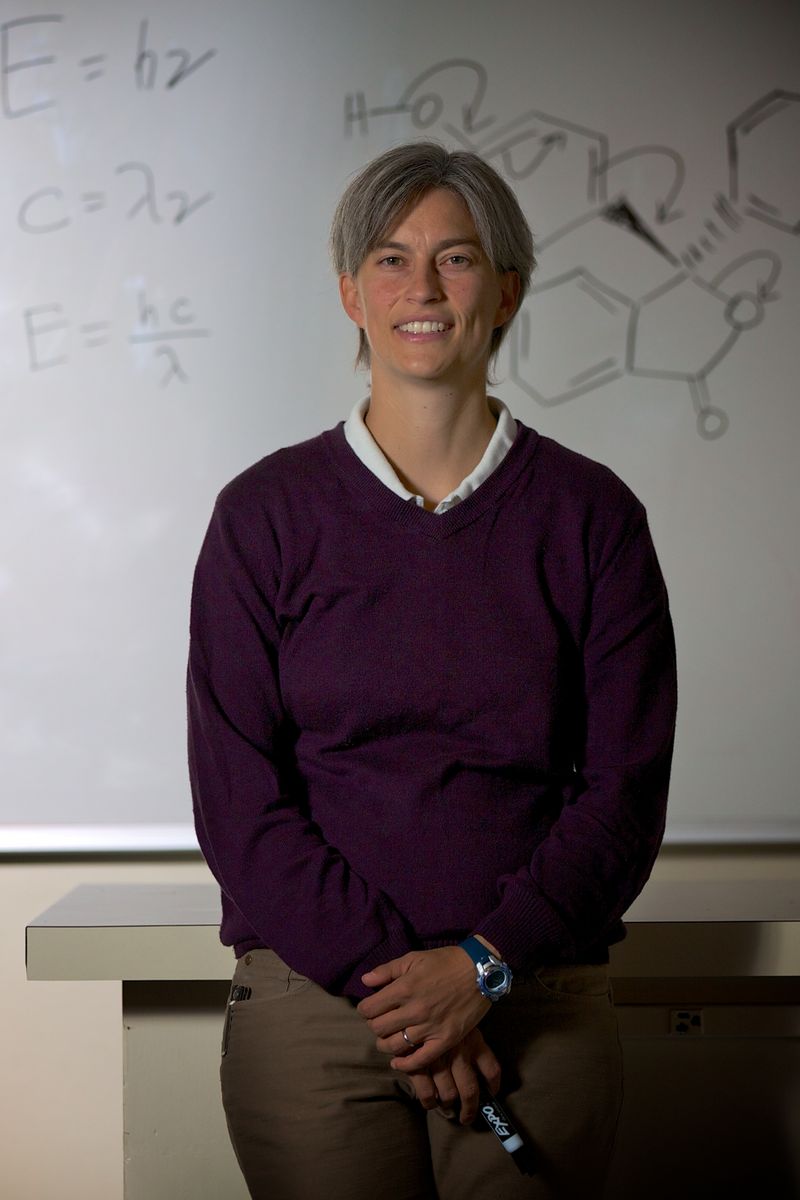
Jennifer Helbley
Contact Information
Email: [email protected] (preferred)
Phone: 951-732-7315 (text)
Office: Palmer Hall 251
Dr. Helbley does not have an office telephone. It is best to e-mail [email protected]. You can also text message her at 951-732-7315 (texts and e-mails are very much preferred over calls).
Appointments
Appointments can be booked at tidycal.com/jhelbley. You will be able to specify either an in person meeting (in Palmer Hall 251) or a location you would like to specify or a virtual meeting using Microsoft Teams. If you would like another virtual meeting type where you will be the meeting host, please use the ‘At your office/another meeting location’ in the meeting location dropdown when you go to book and you can send me the link in email or as part of the appointment booking.
Appointment types generally available:
If there is no availability, I may be extra busy or something went wrong with the internet. Email me with your meeting request and some available times and I will get back to you as soon as I can.
Courses I Teach
Currently teaching
- General Chemistry lecture sequence: CHEM 111, CHEM 112, CHEM 113, and CHEM 121, CHEM 122
- General Chemistry lab sequence (managing content, grading, and overseeing contract instructors): CHEM 111L, CHEM 112L, CHEM 113L
- Organic Chemistry I lecture: CHEM 281
- Organic Chemistry I lab: CHEM 281L
- Advanced Organic Chemistry lecture and lab: CHEM 380, CHEM 380L
- Molecular Science Literature Review & Molecular Science Research Lab: CHEM 321, CHEM 322
- Molecular Science Research Writing: CHEM 421
Previous teaching
- Organic Chemistry II lecture and lab: CHEM 282, CHEM 282L
- Scientific Thinking and Religious Belief: NSCI 405
Education:
- Ph.D., Chemistry, University of Nevada, 2006
- B.S., Chemistry, Walla Walla College, 2001
Principal Research Interests
Most of my recent published work has been in collaboration with the archaeologists at La Sierra University. Together we have explored the identity of the different elements present in pottery using X-ray fluorescence (XRF). This is done using a handheld, portable, XRF that can collect data from a variety of types of specimens including ceramics (pottery is a subset of ceramics), glasses, and metals. Although the technique can be non-destructive, we found that more detailed and consistent results can be obtained by scraping a small sample from the pottery. I am also currently exploring ways to more consistently and conveniently record the colors of various objects that are gathered from the active dig site in Jordan. During the summer of 2014 the chemistry and biochemistry department was happy to award a scholarship for an undergraduate to travel to Jordan and work with the color meter as the dig was in progress.
My other area of interest is the ability of molecules to self-organize as lyotropic liquid crystals. I am working to synthesize an organic molecule that can serve as a solid electrolyte for lithium ion secondary batteries. First the molecules would self-organize when dissolved in water and the solution would be microscopically organized into a pattern using soft lithography techniques. After the molecules have organized, the water can be evaporated and a highly organized solid is left behind. If everything works as planned, then these highly organized molecules would help stabilize the mobility of the lithium ions without trapping them between the electrodes. This would increase the safety of lithium ion batteries and also decrease their weight.
Member of American Chemical Society, American Schools of Oriental Research, and American Society for Biochemistry and Molecular Biology.
Chemistry Research Area:
- Materials Chemistry
- Archaeological Chemistry
- Self-organization
Representative Publications
- J. Helbley, B. Baretto; “N to I transitions of a chromonic lyotropic liquid crystal as measured by differential scanning calorimetry.” Abstracts of Papers, Presented at the 68th Northwest Regional Meeting of the American Chemical Society, Corvallis, OR, July 21-24, 2013; Poster 47.
- J. Helbley, D. Clark, M. Chang, S. Mavingre, M. Shah, and C. Wang; “Composition and physical characterization of an Iron Age pithos.” Abstracts of Papers, Presented at the 243rd American Chemical Society National Meeting & Exposition, San Diego, CA, March 25-29, 2012; Poster ANYL 23.
- M. Shah, M. Chang, J. Helbley, and C. Ji.; “Analysis of Nabataean pottery using X-ray fluorescence.”Abstracts of Papers, Presented at the 243rd American Ammerican Chemical Society National Meeting & Exposition, San Diego, CA, March 25-29, 2012; Poster CHED 351.
- J. Helbley, C.-H. Ji, and C. L. Webster, Jr.; “The Nabatean painted ware from the Dhiban Plateau: chemical analysis, provenance, and socioeconimic implications.” Presented at the 2011 American Schools of Oriental Research Annual Meeting, San Francisco, CA, November 16-19, 2011; Session A64: Technology in Archaeology.
Get instant answers!

 Loading interest form...